
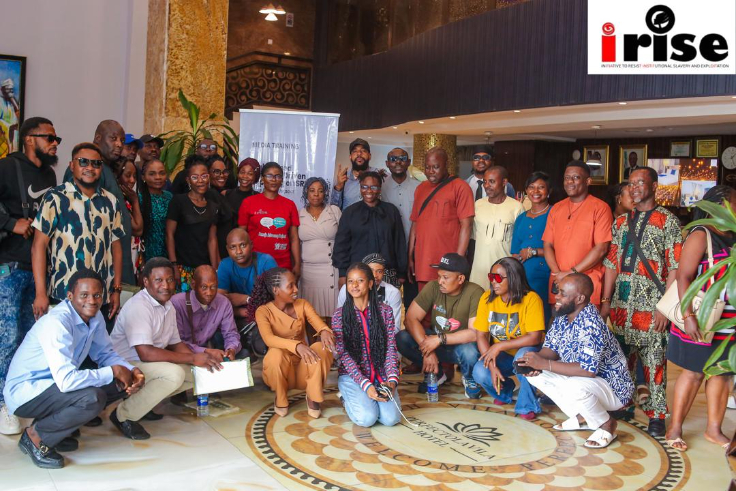
Cross section of participants at the training on Rights-based, evidence-driven reporting in Sexual and Reproductive Health and Rights (SRHR) in Lagos
IRISE has trained journalists on right-based, evidence-driven reporting in Sexual and Reproductive Health and Rights (SRHR). The training aimed to enhance journalists’ understanding of SRHR issues and equip them with skills to report accurately and sensitively.
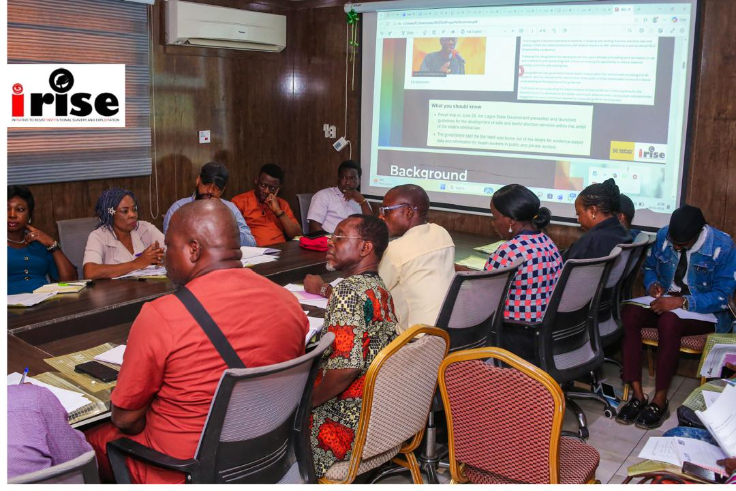
The two-day training which took place in Lagos, had in attendance reporters, editors and publishers and tagged, ‘Rights-based, evidence driven reporting in SRHR: From data to impact.
The training covered topics like SRHR laws, gender-based violence, and data-driven storytelling.
Speaking at the event, the Executive Director of IRISE, Omodele Ibitoye Ejeh, disclosed that the training was designed to bring media professionals together to examine how sexual and reproductive health issues are being reported and how narratives can influence public perception.
“Journalists play a crucial role in shaping public discourse on SRHR hence, we aim to support evidence-based reporting that promotes awareness and advocacy.”
Further she stated that the media plays a critical role in shaping societal understanding of sensitive issues, including abortion and survivors of sexual violence.
She said, “The message is bringing media partners together to look at how sexual and reproductive health and rights are being reported and what picture the media is painting, especially around abortion rights and human autonomy,” she said.
Ibitoye Ejeh also revealed that the event was also to highlight the Safe Termination of Pregnancy guidelines introduced by the Lagos State Government in 2022 to guide service providers in protecting the lives of women and girls.
According to her, the guideline was misunderstood and subsequently suspended shortly after its launch. “The guideline is not a law promoting abortion. It is meant to guide service providers on how to protect the lives of women and girls from dying due to unsafe practices,” she explained.
She added that IRISE is currently engaging policymakers, community leaders and the media to create awareness about the guideline and advocate for its reinstatement.
“Our call to action is that the guideline should be reinstated. Lagos is a pace-setter, and when Lagos leads, others will follow,” she said.
Ejeh also stressed the need to address stigma and victim-blaming in cases of sexual violence, calling on society to hold perpetrators accountable and support survivors.
Speaking also was the Coordinator of the African Women Lawyers Association of Nigeria, Lagos State Branch, Adesola Bello, who stressed the importance of Ethical Reporting in Cases Involving Survivors of Sexual and Gender-based Violence.
She encouraged journalists to avoid judgmental language and ensure that reports do not expose survivors to further trauma.
Bello defined SRHR from a human right perspective, saying that it refers to the right of every person to make decisions about their body free from discrimination, access quality reproductive health services and enjoy bodily autonomy and dignity
According to Bello, “Ethical reporting should not be judgmental. Journalists should focus on the perpetrators and the offence committed rather than the survivor’s actions or behaviour,” she said.
She further noted that consent must be obtained before sharing survivors’ stories and warned against publishing explicit details that could stigmatise survivors.
On challenges affecting prosecution of cases, she explained that stigma often discourages survivors from pursuing justice. “Sometimes it is not really poverty; it is the stigma survivors are trying to avoid,” Bello said.
She also called for continued sensitisation of law enforcement officers to ensure that survivors are treated with dignity and respect.
Bello advised survivors of abuse to seek immediate help at medical centres or report to the gender unit of the police to enable proper investigation and access to justice.

A Data Analyst and Monitoring and Evaluation Officer, IRISE, Esther Udoh, who spoke on the topic, Evidence-driven Reporting: Using Verified Data, Research and Statistics in Stories, Fact-Checking Tips, said that the media has to understand that data is very important.
She added that stories without data are just opinions. She said “Data brings credibility and evidence to a report.
Journalists commended IRISE for the valuable insights and pledged to use their skills to amplify SRHR voices.
About the Author