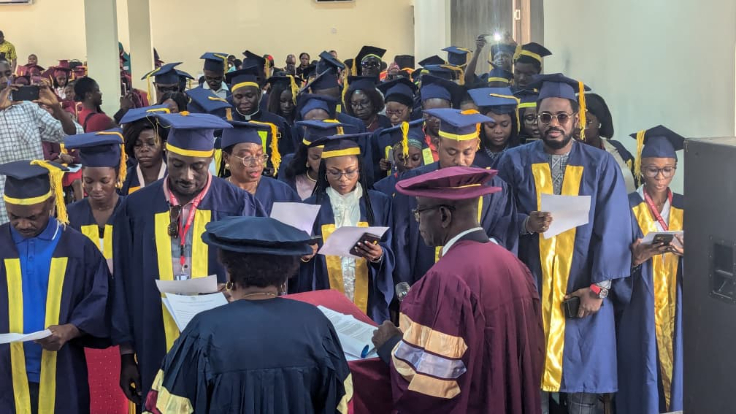
Postgraduate Diploma (PGD) Students of Nigerian Institute of Journalism (NIJ), Ogba, Lagos taking oath of admission during 2025/2026 matriculation ceremony today at Sir Kesington Adebutu Resource Centre.
*NIJ is not a certificate factory
The Nigerian Institute of Journalism (NIJ) has matriculated 293 new students, urging them to become ethical and digital-savvy journalists to impact meaningfully to the growth and development of the country while shaping the nation’s media landscape for excellence.
The provost of the institution, Mr. Gbenga Adefaye, while delivering his speech on the occasion of the 23rd Matriculation Ceremony, held on Wednesday, at the Sir Kesington Adebutu Media Resource Centre, Ikeja, Lagos, emphasised the need for factual reporting and digital literacy especially in today’s media industry.
“As journalists, you’re expected to drive truth, not spread misinformation,” Adefaye said. “Embrace digital tools—Journalism and applied mass communication are being reshaped by digital technology, artificial intelligence, data-driven storytelling, and an increasingly complex information ecosystem but never compromise ethics.”
He noted that the modern media professional must be skilled not only in reporting but also in multimedia production, podcasting, digital investigations, fact-checking, and strategic content management.
According to him, “The media environment is increasingly complex. Artificial Intelligence (AI) is real and will seriously impact the media business ecosystem. The rise of social media, deepfakes, and misinformation has heightened the responsibility of professional communicators. Fake news is no longer a nuisance—it is a threat to public trust and democratic stability. Your training in NIJ is therefore both a privilege and a public responsibility.”
The provost, however, highlighted NIJ’s commitment to producing industry-ready journalists, equipped with skills to navigate the digitally evolving media landscape.
Adefaye explained that HND students who complete their programme would be eligible for NYSC mobilization, placing NIJ graduates on equal professional footing with their peers nationwide.
He underscored the need for the matriculants to lead and navigate the media space through competence, courage and conscience.
“Your education at NIJ is structured to prepare you not merely to adapt to this change, but to lead it with competence, courage, and conscience with future eligibility for NYSC mobilization.
In the matriculation ceremony of the 2025/2026 academic session, 138 were for National Diploma (ND), 69 Higher National Diploma (HND) and 86 Postgraduate Diploma (PGD) comprising of 293 students, each representing a future voice in Nigeria’s media and public communication landscape.
NIJ Provost calls for professional appearance and conduct
He urged the student to appear professionally, noting that, “Journalism is a profession of credibility. Your appearance and conduct must reflect that standard at all times.
“NIJ is not a certificate factory. We are a professional academy committed to producing ethical, disciplined, and socially responsible communicators dedicated to truth, accountability, and public interest,” Adefaye stressed.
He identified curiosity, respect for diversity, resilience in the face of challenges, and commitment to community as guiding principles to attaining success in the course of studies.
“As you begin this journey, I offer four guiding principles: curiosity, respect for diversity, resilience in the face of challenges, and commitment to community.”
He advised the students to focus on becoming world leaders, innovators and ethical custodians of public information and not merely to earn a certificate.
He said, “Nigeria needs journalists and applied mass communicators who are courageous, competent, and ethically principled. NIJ will equip you with the skills, confidence, and professional identity that will define your career long after graduation.”
He also listed professional development opportunities available to students, including field trips to media organizations, participation in national competitions, intensive newsroom practice in print, broadcast, and digital media, and student industrial work experience. “Many media companies today directly ask for our best interns for employment,” he added.
About the Author