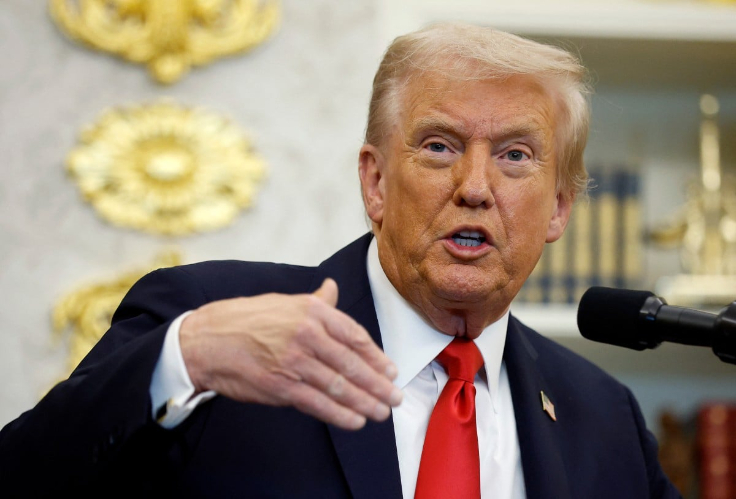
Washington, DC-October 16: U.S. President Donald Trump answers questions from reporter during an event in the Oval Office of the White House in Washington DC. Kelvin Dietsch/Getty image/AFP
Following the signing of the National Defence Authorisation Act (NDAA) into law, the United States on Friday approved $413 million for counter-insurgency and security operations in Nigeria and other West African countries in the 2026 fiscal year.
The funding, which is allocated under the United States Africa Command (AFRICOM) budget, would reflects Washington’s response to escalating insecurity across the region.
The funding would form a wider defence spending package that authorises $901 billion in total military expenditure and includes a four per cent pay rise for US service members, marking the 65th consecutive annual defence authorisation.
The Act however, does not provide a country-by-country breakdown of the $413 million, the sum represents the full amount requested by AFRICOM for its Africa operations and maintenance budget.
The approval comes amid rising threats from jihadist groups, armed bandits and maritime criminals across Nigeria and neighbouring states.
Nigeria continues to grapple with a prolonged insurgency in the North-East, expanding banditry in the North-West, and piracy in the Gulf of Guinea. Elsewhere, Mali faces renewed militant pressure, while northern Benin has experienced spillover violence from the Sahel.
Beyond funding, the defence law introduces notable policy changes. It establishes a new Assistant Secretary for African Affairs at the US State Department and creates a Bureau of African Affairs to coordinate US foreign policy and assistance across sub-Saharan Africa.
The legislation also mandates a comprehensive review of Russia’s military activities and posture in Africa, a move likely to shape US strategic planning involving AFRICOM, Central Command and European Command.
About the Author