
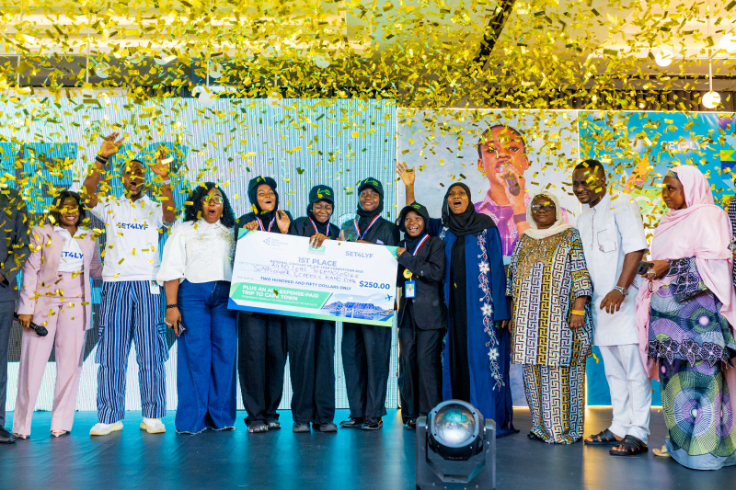
Agrolens Technologies of Sunflower School, Kano State, has emerged winner of Junior Achievement Nigeria’s (JAN) 2026 National Company of the Year (NCOY) Competition, earning a US$250 cash prize and an all-expenses-paid trip to Cape Town, South Africa, to represent Nigeria at the African Company of the Year (ACOY) Competition.
The winning team, comprising Fadillah Abdulsalam, Ruqayya Jallo, Hayfa Mukhtar and Maryam Butu, developed AgroLens AI, a free, artificial intelligence-powered mobile platform designed to help farmers make informed agricultural decisions.
The platform integrates crop disease and pest detection, treatment recommendations, real-time market price information, connections to buyers and access to agricultural financing resources.
Designed to make agricultural information more accessible, AgroLens AI supports English, Hausa, Yoruba, Igbo and Nigerian Pidgin. Its voice-enabled features are intended to serve farmers who have limited literacy or prefer speaking to typing. By bringing crop health guidance, market intelligence and financing connections together, the platform seeks to address multiple challenges facing farmers through a single, accessible solution.
The winners were announced at the National Company of the Year Competition and National Stakeholder Convening, held on Wednesday, 21 October 2026, under the theme, “Augmenting Innovation: Equipping Nigeria’s Youth for Entrepreneurship and Livelihoods in a Changing Economy.”
The event convened stakeholders from government, the private sector, education and the development community to explore how entrepreneurship education, digital skills and cross-sector partnerships can expand economic opportunities for young Nigerians.
New Era Company of Community Secondary School, Asokoro, Abuja, placed second, receiving US$150, while Nexora of International School Lagos came third, winning US$100. New Era Company also received the Best Corporate Social Responsibility (CSR) Award, accompanied by an additional US$100 prize.
The competition is a key component of Junior Achievement Nigeria’s School-to-Work Educational Transition for Long-Term Youth Fulfilment (SET4LYF) programme, which equips girls with the practical skills, knowledge and experience to transition from school to further education, entrepreneurship and employment.
Through initiatives such as Ideathons, JA DEEP and the JA Company Program, participants build digital capabilities, develop solutions to real-world challenges and gain hands-on experience in creating, managing and presenting business ideas.
In his welcome address, Mr Olaolu Akogun, Acting Executive Director of Junior Achievement Nigeria, emphasised the importance of preparing young people, particularly girls, to navigate a rapidly evolving economic landscape through practical learning and meaningful partnerships.
“The young people we are equipping today cannot afford to be prepared only for the opportunities that existed yesterday. Technology is changing how we work, trade and create value, and our responsibility is to ensure that young Nigerians, especially girls, have the skills, confidence and practical experience to participate in and shape that changing economy,” Akogun said.
He highlighted JAN’s collaborations with the National Youth Service Corps (NYSC), the Joint National Association of Persons with Disabilities (JONAPWD) and state governments, noting that sustained partnerships are critical to expanding access to entrepreneurship education.
Akogun also urged stakeholders to translate the discussions at the convening into actionable recommendations that government institutions, businesses, schools and development partners can implement to strengthen youth empowerment and economic participation.
He noted that the program remained relevant to boost sustainable economic livelihood for young people; vulnerable communities and under deserved communities and persons living with disabilities.
Business intelligence remains key for global relevance – Minister
Delivering the keynote address on behalf of the Honourable Minister of Youth and Social Development, Mr Aliyu Abdullahi, Assistant Director, Education Youth Development, at the Ministry of Youth and Social Development, stressed that business intelligence remains key for global relevance hailed JAN for the entrepreneurship drive.
He also called for a shift from an education system focused primarily on academic qualifications to one that develops practical competence, problem-solving skills and clear pathways to economic participation.
“Junior Achievement Nigeria is doing a lot in equipment our young girls with entrepreneurship skills because business intelligence is the bedrock for global relevance.
“Degrees alone are not enough. We must move young people from being consumers of digital technology to becoming creators, problem-solvers and innovators. Training must lead to opportunity, and opportunity must lead to livelihoods,” Abdullahi said.
A JAN alumnus, he advocated stronger collaboration among government, educators and industry to integrate entrepreneurship, apprenticeships, internships and practical skills into learning. He also stressed the importance of connecting youth development initiatives to market access and emerging opportunities in the digital economy, emphasising that training must translate into tangible livelihood outcomes.
The formal proceedings also featured a cultural performance by students of Araromi Secondary School, Orile Iganmu, Lagos State. Dedicated to celebrating the girl child, the performance reinforced the event’s focus on girls’ empowerment, potential and participation in shaping Nigeria’s future.
A major highlight of the convening was an ecosystem panel discussion titled “Bridging the Gap: From Foundational Learning to Experiential Entrepreneurship and Market Access.” Moderated by Ms Mndepawe Jonah Kwaghe, Acting Head of SET4LYF, the session brought together representatives from entrepreneurship development, project management, disability inclusion, banking and public education.

The panellists were Mr Emmanuel Owoeye, Programme Manager at FATE Foundation; Mr Emeka Oscar Nwachukwu, Partner Success Manager at PMI Nigeria; Mrs Anifat Sadu, Disability Inclusion Facilitator and Author at JONAPWD; Mr Alvin Agorom, a marketing and brand transformation leader at Union Bank; and Hajiya Maimuna Muhammad, Director-General of Schools and Education Reform, Niger State.
Discussions centred on how mentoring, capacity building, project management, disability inclusion and private-sector engagement can help young people turn foundational learning into viable businesses and meaningful economic participation.
Panellists emphasised the need to design inclusive programmes from the outset, strengthen young entrepreneurs’ ability to execute projects and build sustainable businesses, and connect student-led enterprises to their communities, markets and industry networks.
Stakeholders also participated in breakout sessions under the theme “From Programs to Systems: Scaling Digital Capability, Policy and Industry Infrastructure for Sustainable Youth Livelihoods.” The sessions examined the policies, systems and partnerships needed to expand digital capabilities and create more sustainable pathways from education to entrepreneurship and employment.
Beyond the overall competition rankings, several participants and contributors received special recognition for their achievements.
Agrolens Technologies received the Product Innovation and Operational Excellence Award, presented by Food Concepts. UOFAM Group of Company from Unique Secondary School, Akure, won the Public Choice Award, receiving US$50, while EcoFlame Innovation received the Excellence in Project Management & Execution Award from PMI Nigeria.
Mr Ezekiel Yende Sekegh was named Outstanding Volunteer of the Year, while Mr Isaac Chika Egbe of Sunflower School, Kano State, received the Best Facilitator Award, adding to the school’s success in securing the national title.
In another highlight, 15 girls drawn from the 12 competing schools and other participating schools were selected for a fully sponsored leadership training camp in Ghana scheduled for March 2027. Sponsored by Delta Air Lines, the opportunity recognises leadership, commitment, teamwork and excellence demonstrated throughout the programme.
Reflecting on Agrolens Technologies’ victory, Edwin Idoko, Kano State Programme Officer at Junior Achievement Nigeria, highlighted the contributions of state education authorities, volunteers and field officers in supporting the students’ achievement.
He noted that the victory marked Kano State’s third consecutive year of success at the National Company of the Year Competition.
Agrolens Technologies’ achievement demonstrates the value of experiential learning in helping girls develop ideas, collaborate, solve practical problems and build the confidence to pursue entrepreneurial opportunities.
As the team prepares to represent Nigeria at the African Company of the Year Competition in Cape Town, its success underscores the potential of young innovators to develop solutions to real-world challenges when they have access to relevant skills, mentorship and platforms to test their ideas.
The 2026 National Company of the Year Competition was supported by FirstBank Nigeria, Project Management Institute (PMI) Nigeria, Food Concepts (Chicken Republic) and Nigerian Bottling Company.
Junior Achievement Nigeria remains committed to working with public- and private-sector partners, educators and communities to equip young people with the skills, mindset and opportunities needed to participate meaningfully in Nigeria’s evolving economy.
Through SET4LYF, the organisation continues to support girls with the knowledge, practical skills and experiences required to transition from school to further education, entrepreneurship and dignified, fulfilling work.
About the Author