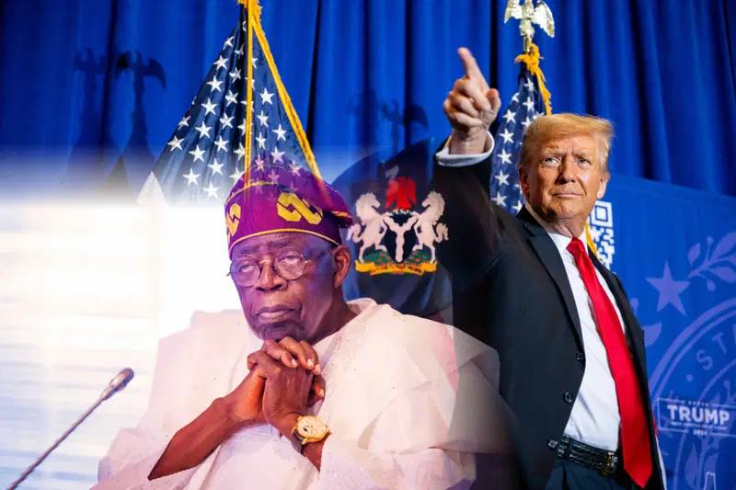
President Bola Ahmed Tinubu and US President Donald Trump
The United States House Appropriators and Foreign Affairs leaders have held a meeting to chart ways to end the alleged Christian genocide in Nigeria.
The meeting which was jointly held would aid the investigation into what lawmakers and experts describe as escalating and targeted violence against Christians in Nigeria.
The session, led by House Appropriations Vice Chair and National Security Subcommittee Chairman Mario Díaz-Balart, R-Fla., is feeding into a comprehensive report ordered by President Donald Trump on recent massacres of Nigerian Christians and potential policy steps the U.S. could take to pressure Abuja to respond.
Trump had directed Congress, led by Reps. Riley Moore, R-W.Va., and Appropriations Chairman Tom Cole, R-Okla., to probe Christian persecution in Nigeria and produce a report for the White House to review.
Vicky Hartzler, chair of the U.S. Commission on International Religious Freedom, told lawmakers that “religious freedom [is] under siege,” citing the abduction of more than 300 children and attacks in which “radical Muslims kill entire Christian villages [and] burn churches.”
She said violations were “rampant,” “violent,” and disproportionately affect Christians who, she argued, were targeted “at a 2.2 to 1 rate”, compared with Muslims.
Hartzler said Nigeria had taken some initial corrective steps, including reassigning about 100,000 police officers from VIP protection details but warned the country was entering a “coordinated and deeply troubling period of escalated violence.”
She recommended targeted sanctions on Nigerian officials “who have demonstrated complicity,” visa restrictions, blocking U.S.-based assets, and conditioning foreign and humanitarian aid on measurable accountability.
She also urged Congress to direct the Government Accountability Office to conduct a review of past U.S. assistance, adding that Abuja should retake villages seized from Christian farming communities, so widows and children could return home.
Dr. Ebenezer Obadare of the Council on Foreign Relations said the violence was not religiously motivated.
According to him, “The idea of Boko Haram and other militant groups targeting Christians and Muslims equally is a “myth,” arguing the groups “act for one reason and one reason only: religion.”
Obadare described Boko Haram as fundamentally opposed to democracy and said the Nigerian military was “too corrupt and incompetent” to dismantle jihadist networks without strong external pressure.
He urged the U.S. to press the Nigerian government to disband armed groups enforcing Islamic law, confront corruption inside the security forces, and demonstrate genuine intent to curb religious violence.
He added that Washington should insist Nigerian officials respond immediately to early warnings of impending attacks.
The nation’s roughly 120 million-strong Muslim population dominates the north, while some 90 million Christians are centered in the southern half of the country.
Nelson urged tighter U.S. oversight of assistance to Nigeria, including routing some aid through faith-based organizations to avoid corruption.
He called for greater transparency in how Abuja handles mass kidnappings and ransom payments, adding that sustained U.S. and international pressure was essential because “without transparency and outside pressure, nothing changes.”
The Nigerian Embassy did not immediately respond to a request for comment.
About the Author