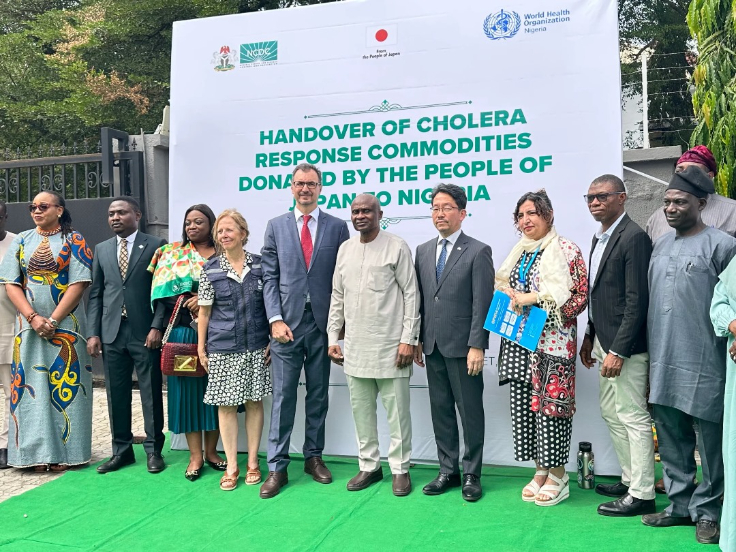
Japan Government as well as the World Health Organisation, has donated $500,000 worth of commodities and equipment, as well as emergency support tools to Nigeria following cholera outbreaks.
As part of the intervention, life-saving commodities valued at $104,951 were handed over to the Federal Government through the Nigeria Centre for Disease Control and Prevention in Abuja.
The support among other things aims to boost Nigeria’s ability to detect and respond rapidly to outbreaks, to curb death.
Between January 1 and August 31, the country recorded 9,738 cases and 234 deaths across the 36 states and the FCT, with states in the North-East and North-West worst affected. The WHO puts Nigeria’s Case Fatality Rate at 2.4 per cent.
WHO Representative and Head of Mission to Nigeria, Dr. Pavel Ursu, said the donation became necessary to tackle cholera transmission risks.
According to him,“I would like to thank the government and people of Japan for their generous support. The $500,000 Japan grant, domiciled at the WHO, has catalysed health interventions that protect vulnerable Nigerians and strengthen the government’s efforts to prevent, detect, and respond to emergencies,” Ursu said. “This contribution is not just a shipment of supplies; it is a lifeline for communities at risk.”
He explained that the donated cholera kit—comprising 29 modules of medicines, equipment, logistics materials, and renewable supplies—can support the treatment of 100 cholera cases during the first weeks of an outbreak.
Ursu said, “the supplies would be deployed strategically to hotspots identified through surveillance and risk mapping, while the organisation continues to support surveillance strengthening, laboratory capacity, case management, and community hygiene promotion.”
The Ambassador of Japan to Nigeria, Suzuki Hideo, said the commodities were procured through Japan’s Supplementary Budget Project on Cholera Outbreak Preparedness and Response in partnership with the WHO.
“The Government of Japan remains steadfast in its belief that every life is precious and that timely, coordinated action can prevent avoidable loss,” Hideo said. “Today’s handover demonstrates Japan’s practical commitment to saving lives, strengthening health systems, and promoting community resilience.”
In his keynote remarks, the Director-General of the NCDC, Dr. Jide Idris, said the support aligns with Nigeria’s National Strategic Plan of Action on Cholera Control (2025–2029) and will enhance treatment, detection, and rapid response at national and sub-national levels.
He said the donations include cholera central and periphery kits, Oral Rehydration Point kits, infection prevention and control materials, laboratory modules, diagnostic tools, sanitation hardware, logistics support, and supplies for treatment centres nationwide.
“These resources will significantly enhance our capacity for treatment, early detection, and rapid response. Cholera remains a recurrent threat driven by inadequate water and sanitation infrastructure, population displacement, insecurity, weak surveillance systems, and insufficient oral cholera vaccine coverage,” Idris said.
About the Author