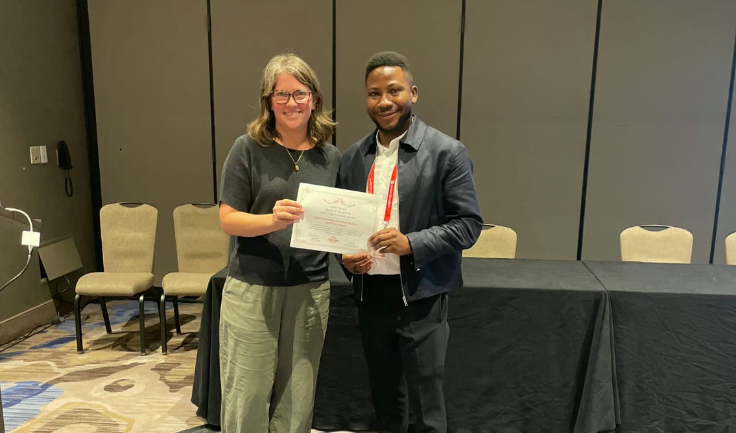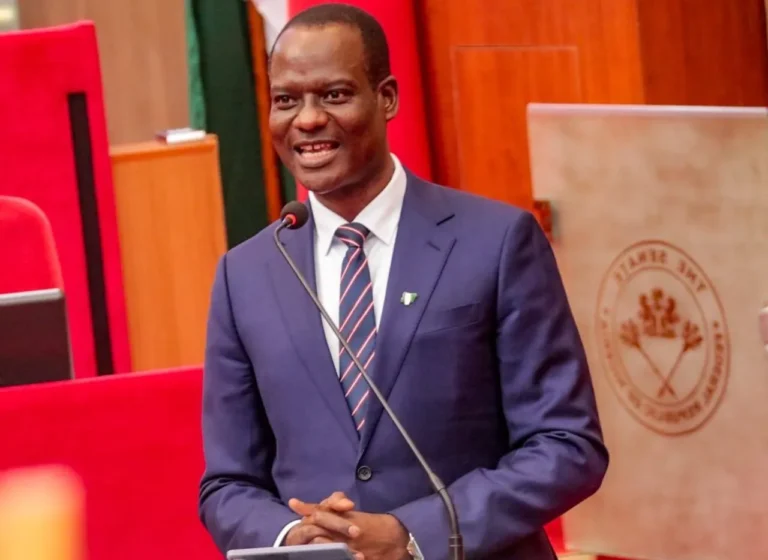
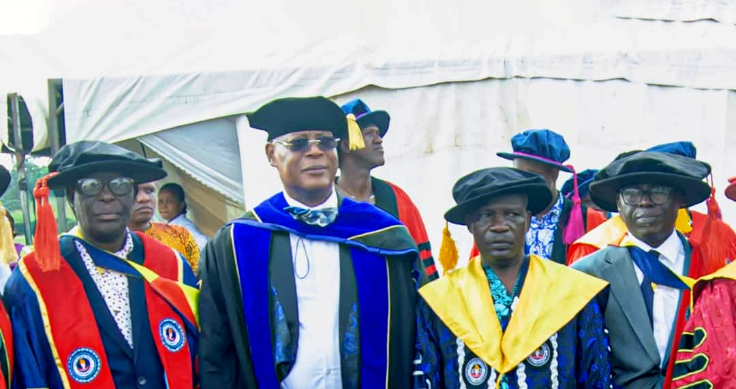
From L-R; The professor of Literary Analysis, Theory and Text-Linguistics at the Department of English, University of Ibadan, Nelson Fashina; the Chancellor, Southwestern University, Engr Babatunde Odufuwa; the Vice-Chancellor, Prof Amusa Adetunji and Abiodun Agbomabiwon, a financial expert conferred with the Doctor of Science degree, honoris Causa for his contribution to national development at the 4th and 5th convocation ceremony held at the Institution campus square, Okun-Owa, Ogun State on Tuesday
The Chancellor of Southwestern University, Engr Babatunde Odufuwa, has stressed the need for graduands in Nigeria to acquire more practical skills to remain globally relevant in today’s competitive job market.
He said, “it is time for Nigeria to balance academic excellence with skills.”
Odufuwa noted that the 21st-century employability space in the world, would give more attention to skills than certificates.
The Chancellor spoke on Tuesday at the institution’s combined 4th and 5th Convocation Ceremonies, held at the University Campus Square, Okun-Owa, in the Odogbolu Council of Ogun State.
Odufuwa, who called for more focused investment in learning, said a nation’s growth and development rest on the quality of education of the people.
He said, “Today we celebrate a significant milestone in the lives of our graduating students. As we confer degrees upon them, we underscore the importance of balancing academic excellence with skills acquisition, which has been the focus of Southwestern University Nigeria.
“Nigeria’s obsession with certificates over skills has led to a plethora of problems, threatening our nation’s development.
“For years, we’ve prioritised academic achievements over practical skills, creating a culture where certificates are valued more than competence. This has led to cheating in exams, inadequate preparation for the workforce, and, worst still, catastrophic consequences. We’ve seen building collapses, avoidable deaths in hospitals, and plane crashes – all attributed to certified but unskilled personnel,” he explained.
The Chancellor who attributed these challenges with skill-gap to government and employers of labour, called for the implementation of policies that would balance academic excellence with skills acquisition.
According to him, “The blame in skill gap lies with the leadership of our dear country, which emphasises academic excellence without promoting skills acquisition, as seen in academic policies and reflected in various curricular of various levels of education.
“Employers also contribute to this problem by prioritising certificates over skills. This has encouraged shortcuts and cheating in examinations just to acquire certificates. The certificates add no value to expertise of most holders and to the nation at large. At best the certificates reflect mediocrity, thereby hindering Nigeria’s growth, particularly in this era of technological innovation, which is very practical and skills oriented.
“To reverse this trend, the three tiers of government in Nigeria must implement policies that balance academic excellence with skills acquisition. Similarly, employers should prioritise skills and the government must work together – federal, state, and local governments – to drive this change,” he stressed.
He advised the graduands to prioritise skills acquisition, saying, “don’t just hold onto the certificate and skills you have acquired at Southwestern University, continue to acquire more skills and improve on them. I believe this is one sure way Nigeria will not be left behind in the ever-changing global village.”
The Vice-Chancellor of the institution, Prof. Amusa Adetunji, congratulated the graduands and charged them to be agents of impact to the society and worthy ambassador of the school.
He reaffirmed the institution’s commitment to always equipped its students with the necessary skills to excel in their chosen fields.
He restated that the institution would continue to produce morally sound graduates, who would positively impact society.
In his convocation lecture, the professor of Literary Analysis, Theory and Text-Linguistics at the Department of English, University of Ibadan, Ibadan Nigeria, Nelson Fashina, said Nigeria has great economic opportunities and resources that could be turned into making the nation economically wide, effective, intentionally competitive and sustainable.
The professor who spoke on the topic, ‘Harnessing Nigeria’s economic potentials for sustainable development,’ said the nation has been begging for economic survival since independence in 1960.
According to him, “It is a complex irony that despite the vast natural economic resources, Nigeria economic growth index since independence in 1960 have been a sordid history of stunted growth.”
He identified corruption and insecurity as the key challenges to harnessing Nigeria economic potential for sustainable development and called for key sectors leverage to boost growth.
He said, “The greatest challenges to harnessing Nigeria’s economic potential for sustainable development is the twin problem of corruption and insecurity hence, for Nigeria to key into global sustainable development goal strategies, the leadership must leverage national resources while protecting the ecosystems, promoting renewable energy and ensuring growth benefits all citizen.
“The government should leverage on tackling the insecurity challenges and leverage the natural resources, boost technology and innovation, enhance infrastructures, strengthen human capital, diversifying beyond oil, promoting MSMEs and improving governance and transparency,” Prof. Fashina said.
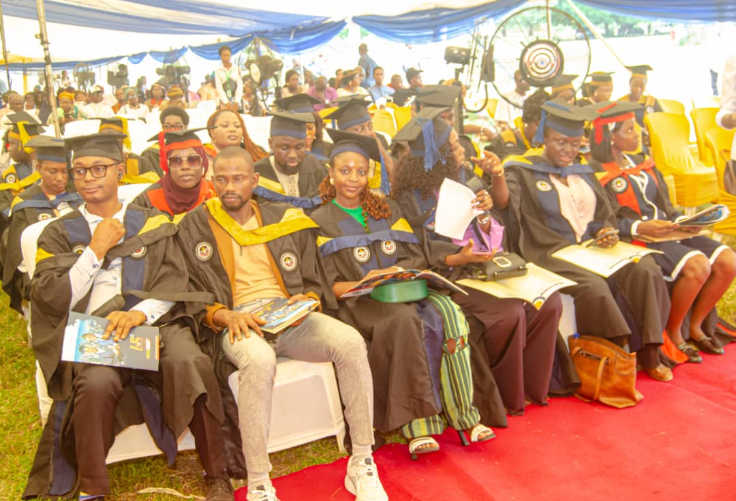
At the convocation ceremony, 810 diplomates were conferred with Bachelor of Science (BS.C) degree from the Faculty of Pure and Applied Science, Faculty of Social and Management Science respectively.
Furthermore, 23 graduated with Post Graduate Diplomas and 32 with Masters of Science from the Post Graduate Studies respectively.
At the convocation ceremony, a financial expert, Abiodun Agbomabiwon was conferred with Doctor of Science degree honoris Causa (D.Sc) for his contribution to national development.
It was also disclosed that the National Universities Commission (NUC) has granted the institution the approval to begin law school in 2026.
About the Author