
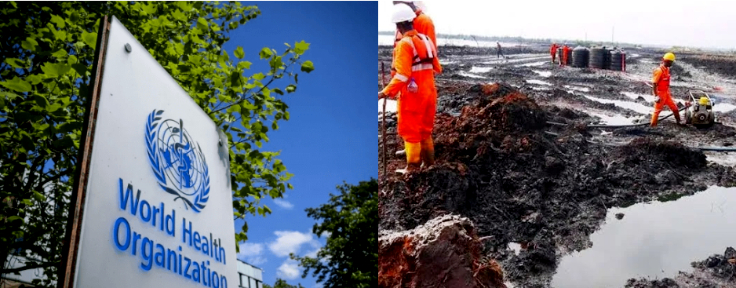
In a bid to salvage the health of residents in Ogoniland, River State, the World Health Organisation on Wednesday begun a comprehensive health probe to prevent ailments associated with long-term exposure to hydrocarbons.
The initiative became imperative as it aligned with the recommendations of the United Nations Environment Programme report.
The report called for follow-up health study to balancing the ecosystem.
The health study is being conducted by the International Agency for Research on Cancer, an agency under WHO.
The Project Coordinator of the Hydrocarbon Pollution Remediation Project, Prof. Nenibarini Zabbey, said the probe became essential as it aligns with the ongoing implementation of the UNEP report.
Speaking during a visit to the traditional rulers of Gokana and Tai local government areas, the Lead Scientist of IARC, Ann Olysson, said the study is part of the UNEP recommendations for Ogoni.
She stated, “We are about, with your permission, to begin a study that was originally recommended by the UNEP study. We are in collaboration with HYPREP to conduct the tests, and the choice of our agency to conduct the study is in international recognition for this type of research.”
Project Coordinator of UNEP and the lead researcher of the 2009–2011 study, Mr Michael Cowing, which led to the report, said one of the key recommendations was this health assessment of the Ogoni population.
He noted that the study will cover 4,000 participants across both the most impacted and non-impacted communities to ascertain results.
“And now, with your approval, we are going to engage in the fieldwork. Simply put, across Ogoniland, we’re looking to have approximately 4,000 participants representing the most impacted communities.
“We know where the epicentres of contamination are. We’ve plotted the communities on those maps, and they will be the impacted communities where we will focus the study. But we are also conducting studies in unimpacted communities for comparison.
“We will be looking at people involved in specific activities, whether farming, fishing, sand mining, or artisanal refining, to assess different levels of exposure to hydrocarbons. So it’s going to be a very comprehensive study,” he said.
Professor Iyenemi Kakulu, of the Department of Land Management at Rivers State University, said participants will be scientifically selected for the study.
“We are also interested in occupational hazards. People exposed by the nature of their work in and around Ogoniland will be subjects of interest. We will talk to them and seek their voluntary consent to participate in the study, which involves collecting some personal data and human samples, such as blood and urine.”
About the Author